Monday, June 29, 2009

S&P warning shows Britain is out of credit

On the other side of the pond...

From Telegraph.co.uk

One of the reasons we know this crisis is no ordinary recession is the prodigious amount by which it is likely to push up the national debt. Before the collapse of Northern Rock, Britain's net public debt to gross domestic product ratio was down at below 40pc – the level widely considered to be consistent with a well-managed economy. In a couple of years' time it is likely to be rather closer to 100pc, thanks to the extra debt incurred in the bank bail-outs, the tax foregone because of the recession and the cost of trying to keep the economy afloat.

But as threatening as this is, it is nothing in comparison with the effect of ageing on our economy. We have committed to paying generations set imminently to retire pensions more generous than we ought to have; providing healthcare more expensive than we anticipated. Tie this to the fact that the population is greying, meaning there are ever fewer taxpayers to support those in retirement, and you have the recipe for a full-scale fiscal disaster.

Americans' savings rate jumps, but there's a catch

From Latimes.com


The government's measure of Americans' savings rate soared in May to the highest level in 15 years, but the number isn't quite what it seems.

The Commerce Department measures total personal income, then deducts personal spending to arrive at what was saved.

That isn't a very reliable way to determine whether or how much people actually are saving, because a single month's data can be skewed by unusual items.

That's what happened in May: One-time federal stimulus payments of $250 each to retirees and others receiving government aid -- so-called transfer income -- drove total personal income up 1.4% from April, while spending rose a modest 0.3%.

That boosted what the government calculates was left in people's pockets. Savings as a percentage of total disposable income jumped to 6.9% from 5.6% in April.

Whither the Dollar?

From Thenewamerican.com

As the fallout from the global financial crisis continues, the burning question in international financial circles is whether the U. S. dollar, the world’s reserve currency since the Second World War, can retain its status. Chinese and Russian leaders have already signaled their distaste for continued dollar hegemony, and the latter have even taken the extraordinary step of publicly seeking assurances that their dollar-denominated assets — U.S. government debt — will be protected.

Pessimism Rising Despite Obama's Popularity

From Nationaljournal.com

Three new polls are out, and all convey the same message: Progress in Washington has stalled, partly because President Obama is more popular than his policies.

Take the CBS News/New York Times poll, which gave the president an overall approval rating of 63 percent. Obama gets just shy of 60 percent approval on foreign policy and terrorism, his strongest issues. His economic rating is holding up reasonably well (57 percent approval), even though the prevailing sentiment is that the president's economic policies have not yet had much effect.

On health care, Obama's ratings are less than 50 percent. Many Americans are not yet familiar with his health care proposals.

The president gets his worst marks on his handling of the auto industry (41 percent approval). The public doesn't like bailouts. "Some of those things are popular; some of those things are not popular," White House press secretary Robert Gibbs commented in response to the poll. "I think the president would tell you that he's going to do what he thinks is in the best interest of the American economy."

Bottom line? In the NBC News/Wall Street Journal poll, three-quarters of Americans said they like Obama. But only about half (51 percent) said they support his policies.

People think that the economic recovery may be slowing. From February to May, more Americans began to think that the economy was getting better (5 percent in February, 26 percent in April, 32 percent in May), according to the CBS/Times poll. But now the number of optimists has dwindled a bit -- to 27 percent.

The Pew Research Center poll? From January to May, the number of people who said they were satisfied with the way things are going in the country increased from 20 percent to 34 percent. Now the number has sagged to 30 percent.

Swelling Deficit Could Slow Recovery

From Forbes.com

In the midst of the worst U.S. economic recession in the post-war period, President Barack Obama in February presented Congress with a budget blueprint that packaged an exceptionally expansionary policy with the rhetoric of fiscal responsibility. However, the prospect of the budget deficit remaining in excess of $1 trillion per year over the next decade raises a number of concerns about longer-term interest rates and the value of the dollar.

1. Inflation danger. The prospective rise in the federal debt-to-GDP ratio to 82% by 2019 raises the likelihood of high long-term interest rates that would be harmful for longer-term economic growth. Large public borrowing requirements would require the Federal Reserve to follow a more restrictive monetary policy approach to contain inflation, while a large rise in the public debt-to-GDP ratio could put the U.S. government's AAA debt rating in jeopardy.

2. Entitlement program concerns. The projected trajectory of the deficit over the next decade is likely to deepen concern about the major challenges to the U.S. public debt outlook in the decades ahead due to the unfunded nature of U.S. social security programs as the baby boom generation reaches retirement. In the absence of policy changes, Social Security (the state pension) and Medicare (government health care for the elderly) outlays will together increase from 8.5% of GDP today to 12.5% of GDP by 2030.

3. Pressure on the dollar. The prospective large public-sector borrowing requirements over the next decade are likely to raise concerns for the dollar. Already foreigners finance close to 50% of the U.S. budget deficit (lumping together central banks, foreign wealth funds, non-U.S. pension and investment funds and non-U.S. corporations) and hold over $3 trillion in U.S. government paper. It would seem implausible to expect foreigners to indefinitely fund such large deficits, especially when they are already voicing concerns about fiscal sustainability.

4. Interest rates. The prospect of large budget deficits is undermining the Federal Reserve's efforts to reduce long-term interest rates as a means to stimulate the economy and stabilize the housing market. In March, after having reduced the federal funds rate to a range between zero and 0.25%, the Fed indicated that it would try to reduce long-term interest rates by:


Fed Douses Purchases Talk, Urges Investors to ‘Relax’

From Bloomberg.com

Federal Reserve officials, encouraged by signs the recession is easing, doused speculation they will pump more money into the economy to hold down interest rates, while indicating they’re not ready to begin a retreat.

Fed policy makers voted yesterday to maintain the size and pace of their $1.75 trillion program to buy mortgage debt and Treasuries. The central bank said it sees a “gradual resumption of sustainable” growth even as “substantial” economic slack holds down inflation pressures.

The statement indicated policy makers need more time to assess the prospects for a recovery starting in the second half of the year before deciding to embark on any exit from their unprecedented credit programs. Complicating their task is an increase in Treasury yields, which yesterday’s message failed to stem: 10-year rates rose five basis points, the most in almost a week, and a further two basis points to 3.71 percent today.

“The Fed is reminding the hyperventilating bond market that it needs to relax,” said Chris Rupkey, chief financial economist at Bank of Tokyo-Mitsubishi UFJ Ltd. in New York. “Inflation will be low for some time because the economic weakness will be with us for a time. They are not about to start to thinking about an exit strategy.”

Decline and Fall:

From Encorepub.com

As inevitable as the rising of the sun in the morning and its descent in the evening, eventually, every great empire in history reaches its summit of outermost expansion, its moment of greatest wealth, power and influence. And then, decline and fall inevitably follow.

Assyria. Persia. Macedonia. Rome. Byzantium. Britain. History is replete with examples of nations that dominated the politics and economies of an era, and, once they reached their zeniths, subsequently returned to a relatively minor status among nations. Through the ill-advised decisions of a nation’s leaders, suffice to say, some fell quicker than others.

America will be no different. The only question is how quickly the nation’s leaders wish to travel down the road to serfdom.

Sunday, June 21, 2009

A Nation of Deficit Hawks Or Hypocrites?

From Theatlantic.com

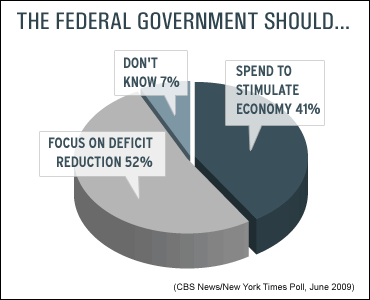
The Journal poll has a solid majority (58%) agreeing that "The President and the Congress should worry more about keeping the budget deficit down, even though it may mean it will take longer for the economy to recover." The Times poll has a majority (52%) siding with the view that the "federal government should NOT spend money to stimulate the national economy and should instead focus on reducing the budget deficit." And YES, all caps in the original.

I find this odd because Americans overwhelming supported the recent effort to ... spent a humongous pile of money stimulating the economy. You can find a rundown of 11 polls on this here. In every poll -- every single poll -- a big plurality of Americans supports the stimulus, and in nine of the polls a majority of the public supports it. Sometimes as much as 70% of the public supports it.
I know public opinion is complicated and preferences can work on many levels and so forth, but I would have thought it would take at least six months to do a complete somersault on this.

Twin Threat: Jobless Rate, Deficit

From Wsj.com

President Barack Obama faces a dilemma as he fights the recession: The public identifies both rising unemployment and soaring budget deficits as its top policy concerns -- but fixing one could worsen the other.

Mr. Obama can ill afford to lose public support on the cusp of the biggest political fights of his presidency, over health care, energy and financial reregulation. Three separate polls this week, including one from the Wall Street Journal/NBC News, have raised red flags at the White House that the president, though still personally popular, is losing some ground with the public on his economic policies.

Officials concede there is little the president can do to please everyone, given the economic Catch-22. If he heeds concerns on the deficit and pulls back on economic stimulus, he risks choking off the "green shoots" of what may be a fledgling recovery.