
President Obama's budget will likely produce $13 trillion in deficit spending over the next 10 years--nearly $4 trillion more than forecast. The White House figures are based on unrealistic estimates of discretionary spending, interest payments, and interest rates. The White House also used budget gimmicks to hide the full cost of certain entitlements and failed to account for the full costs of cap-and-trade energy legislation and health care reform.
Friday, September 25, 2009
President Obama's Agenda Would Bring $13 Trillion in Budget Deficits, Not $9 Trillion
From Heritage.org


Americans believe Washington squanders half of every tax dollar
From wsj.com
If you want to know why Americans are so fearful of a government takeover of the health-care system, take a look at the results of a new Gallup poll on government waste released Sept. 15. One question posed was: "Of every tax dollar that goes to Washington, D.C., how many cents of each dollar would you say is wasted?" Gallup found that the mean response was 50 cents. With Uncle Sam spending just shy of $4 trillion this year, that means the public believes that $2 trillion is wasted.
In a separate poll released on Monday, Gallup found that nearly twice as many Americans believe that there is "too much government regulation of business and industry" as believe there is "too little" (45% to 24%).
Perhaps most significantly, in both of these polls Gallup found that skepticism about government's effectiveness is the highest it's been in decades. "Perceptions of federal waste were significantly lower 30 years ago than today," say the Gallup researchers. Even when Ronald Reagan was elected president in 1980 with the help of the antigovernment revolt of that era, Americans believed only 40 cents of every dollar was wasted, according to Gallup.
Coming next year: Cash deficits in Social Security
From Kansascity.com
Pretty soon all the people who talked about the "money" in the trust fund will learn otherwise. The CBO projects that the first cash deficits since the 1980s will show up next year and 2011. Ed Morrissey has the details at Hot Air.
During the Bush administration, opponents of reforming the system constantly repeated the refrain that when payroll taxes can no longer provide enough for Social Security outlays, the program will simply tap Treasury securities in the trust fund.
But that's when we'll find out those bonds are like IOUs you wrote yourself after tapping your kids' college fund. They can't be redeemed without doing what you would have to do if they didn't exist: Raise taxes, borrow more or cut spending.
The cash shortfall wasn't supposed to happen until 2017, but thanks to the weak economy, the problem is showing up a lot sooner.
Recipients will still receive their payments, but much of that money will come from the general fund, not payroll taxes.
Friday, September 18, 2009
Treasury to Shrink Financing Program
From Wsj.com
The Treasury Department is expected to begin winding down a temporary program created at the height of the financial crisis to address a new problem -- the government's rapidly expanding debt.According to people familiar with the matter, the step is being taken to help the Treasury avoid hitting the $12.1 trillion debt ceiling that was expected to be reached by mid-October. The decision could also be controversial, since the program was put in place to help blunt any inflationary impact from emergency actions taken by the Federal Reserve.
Since last year, the Treasury has been selling special short-term securities and placing the proceeds in an account at the Fed. The program, known as the Supplementary Financing Program, reached about $560 billion late last year, but has since fallen to about $200 billion, where it has remained throughout 2009.
Government officials estimate that decreasing the size of the Supplemental Financing Program could give the U.S. as much as six weeks of additional time.
China Asks Citizens to Buy Gold and Silver
From Ethiopianreview.com
China currently owns more than a trillion dollars of the government's debt. The Chinese have lent the United States money in the past, because they felt it was in their best interest. Because they have such a large investment in our finances, they have in the past lent to us. As they lose confidence in the US economy, they are less eager to lend money. In February, Luo Ping, who is a director-general for the Chinese Banking Regulatory Commission, stated "we hate you guys" when referring to the US government's spending binge. They are clearly not happy about lending to the US government, because it has failed to clean up its spendthrift ways.
Getting out of Dollars
Although the Chinese government is still buying dollars, they are slowly divesting of their investments, spending more dollars than they are buying. At the same time that China has been slowly reducing their dollar holdings, the country has been
investing in gold by investing in gold mines. The Chinese must believe that it is in their best interest for their citizens to buy gold, or they wouldn't be pushing their citizens to do so.If the Chinese government continues to dump US dollars, they will have less of an incentive to keep the dollar afloat. This could result in inflation, or perhaps even hyperinflation, for the dollar. By encouraging the citizens of the most populous country in the world to purchase precious metals, the supply of gold and silver could become limited, causing an increase in the price.
Senate urged to raise $12T debt cap
From Politico.com
Six major trade associations urged Senate leaders to quickly to raise the $12.1 trillion cap on the national debt, a move that will undoubtedly cause political headaches for Democrats facing serious questions about the cost of health care reform.
Treasury Secretary Timothy Geithner warned Congress at the beginning of August that the current limit on how much the federal government can borrow could be hit as early as mid-October.
How Much Debt Is Too Much?
From Forbes.com
The latest budget projections show the national debt rising from $5.8 trillion last year to $7.6 trillion this year and $14.3 trillion in 2019. According to the Congressional Budget Office (CBO), the debt will rise from 40.8% of the gross domestic product in 2008 to 53.8% in 2009 and 67.8% in 2019.
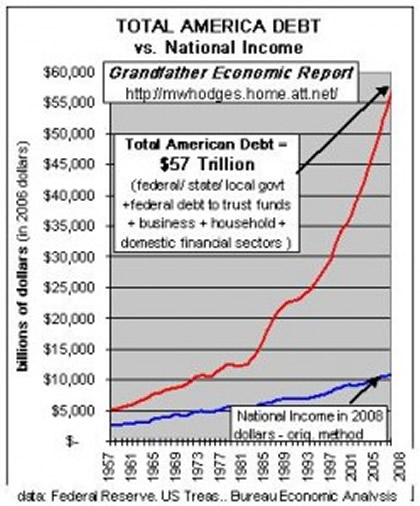
Today the total US debt to GDP is approx 425%.
From Marketoracle.co.uk
The question is, can this debt reach 100% of GDP at around $13 trillion. Putting things into context…before the Great Depression in 1929 the US Govt debt was only 15% of GDP! To make matters even worse, the US in 1929 was a creditor nation. Today the US is a debtor nation. Comparing the current situation to the situation prior to the Great Depression total US debt (individual, business,local, state and federal) was approx 170% of GDP.
Today the total US debt to GDP is approx 425%.
Could the US ,the UK as well as the rest of the world be entering a crisis worse than the Great Depression? I state this because of the amount of debt that in all reality can not be paid back. I am not even mentioning all the trillions of derivatives floating around, that are virtually WORTHLESS! Can the situation really get worse because the whole world is in the same boat? The interwining of the global economy is unprecedented in world history.
I believe in real assets. I have never heard of any country has ever solved a credit crisis by printing more money. When countries print money…eventually inflation ( the wealth destroyer) raises it ugly head. We saw first hand in 1998 Debt Deflation in East Asia brought on tremendous inflation. Nothing ever changes.
Thursday, September 10, 2009
Social Security is Broke
From Thehill.com
The CBO now projects that Social Security’s costs will exceed tax income in 2010 (next year!) and 2011, with cash surpluses returning over the 2012-2015 period and becoming negative again beginning in 2016 and later. In their March 2009 estimates, the CBO projected that the cash surplus would be positive through 2016. Keep in mind that these projections are based on what many economists of all stripes believe are far-too-rosy White House budget numbers. It's a very real possibility that a positive cash surplus may not occur at all.
Subscribe to:
Posts (Atom)
